Big Idea Daily | The Practicing Stoic

 |
A Philosophical User's Manualby Ward Farnsworth |
“If Stoics are distinguished by one policy as an everyday matter, it is a refusal to worry about things beyond their control or to otherwise get worked up about them.”WARD FARNSWORTH |
BIG IDEA
Judgment: The First Principle of Practical Stoicism
FROM THE BOOK“The first principle of practical Stoicism is this: we don’t react to events; we react to our judgments about them, and the judgments are up to us.
We will see the Stoics develop that idea in the pages to come, but this expression of it is typical: If any external thing causes you distress, it is not the thing itself that troubles you, but your own judgment about it. And this you have the power to eliminate right now. – Marcus Aurelius, Meditations The Stoic claim, in other words, is that our pleasures, griefs, desires and fears all involve three stages rather than two: not just an event and a reaction, but an event, then a judgment or opinion about it, and then a reaction (to the judgment or opinion). Our task is to notice the middle step, to understand its frequent irrationality, and to control it through the patient use of reason. This chapter starts with noticing. Later chapters will talk about the irrationality and offer advice about control. We begin here because the point is foundational. Most of the rest of what the Stoics say depends on it. Soon we will hear from them about ‘externals,’ desires, virtues, and much else. But it all begins with the idea that we construct our experience of the world through our beliefs, opinions, and thinking about it—in a word, through our judgments—and they are up to us.” |
Brian's Notes
Welcome to the first words of Chapter #1.
The #1 most important, foundational distinction of Stoicism?
It’s that THIRD step.
We need to know (!) that our reactions to life are not determined by events. Influenced, yes. Determined? No.
There aren’t just two steps: EVENT → REACTION.
There are THREE steps: EVENT ← JUDGMENT → REACTION.
This is why Marcus Aurelius says: “If any external thing causes you distress, it is not the thing itself that troubles you, but your own judgment about it. And this you have the power to eliminate right now.”
And why Viktor Frankl (who, as we discussed in How to Be a Stoic, was deeply influenced by Stoicism) told us that our freedom exists in the GAP right between a stimulus and our response.
As he would say, it’s not: STIMULUS → RESPONSE.
It’s STIMULUS ( — GAP — ) RESPONSE.
Really getting this idea (via thinking about it AND practicing it!) is essential to getting Stoicism and applying its wisdom to our lives. In fact, this is why Ryan Holiday kicks off his year’s worth of meditations in The Daily Stoic with EXACTLY the same distinction.
We’ve shared this passage a few times but it so perfectly captures the point we’ll soak our minds in it again: “The single most important practice in Stoic philosophy is differentiating between what we can change and what we can’t. What we have influence over and what we do not. A flight is delayed because of weather—no amount of yelling at an airline representative will end a storm. No amount of wishing will make you taller or shorter or born in a different country. No matter how hard you try, you can’t make someone like you. And on top of that, time spent hurling yourself at these immovable objects is time not spent on the things we can change.
The recovery community practices something called the Serenity Prayer: ‘God, grant me the serenity to accept the things I cannot change, the courage to change the things I can, and the wisdom to know the difference.’ Addicts cannot change the abuse suffered in childhood. They cannot undo the choices they have made or the hurt they have caused. But they can change the future—through the power they have in the present moment. As Epictetus said, they can control the choices they make right now.
The same is true for us today. If we can focus on making clear what parts of our day are within our control and what parts are not, we will not only be happier, we will have a distinct advantage over other people who fail to realize they are fighting an unwinnable battle.”
Here’s to stepping in between stimulus and response. And choosing our Optimal response. Moment to moment to moment. TODAY.
The #1 most important, foundational distinction of Stoicism?
It’s that THIRD step.
We need to know (!) that our reactions to life are not determined by events. Influenced, yes. Determined? No.
There aren’t just two steps: EVENT → REACTION.
There are THREE steps: EVENT ← JUDGMENT → REACTION.
This is why Marcus Aurelius says: “If any external thing causes you distress, it is not the thing itself that troubles you, but your own judgment about it. And this you have the power to eliminate right now.”
And why Viktor Frankl (who, as we discussed in How to Be a Stoic, was deeply influenced by Stoicism) told us that our freedom exists in the GAP right between a stimulus and our response.
As he would say, it’s not: STIMULUS → RESPONSE.
It’s STIMULUS ( — GAP — ) RESPONSE.
Really getting this idea (via thinking about it AND practicing it!) is essential to getting Stoicism and applying its wisdom to our lives. In fact, this is why Ryan Holiday kicks off his year’s worth of meditations in The Daily Stoic with EXACTLY the same distinction.
We’ve shared this passage a few times but it so perfectly captures the point we’ll soak our minds in it again: “The single most important practice in Stoic philosophy is differentiating between what we can change and what we can’t. What we have influence over and what we do not. A flight is delayed because of weather—no amount of yelling at an airline representative will end a storm. No amount of wishing will make you taller or shorter or born in a different country. No matter how hard you try, you can’t make someone like you. And on top of that, time spent hurling yourself at these immovable objects is time not spent on the things we can change.
The recovery community practices something called the Serenity Prayer: ‘God, grant me the serenity to accept the things I cannot change, the courage to change the things I can, and the wisdom to know the difference.’ Addicts cannot change the abuse suffered in childhood. They cannot undo the choices they have made or the hurt they have caused. But they can change the future—through the power they have in the present moment. As Epictetus said, they can control the choices they make right now.
The same is true for us today. If we can focus on making clear what parts of our day are within our control and what parts are not, we will not only be happier, we will have a distinct advantage over other people who fail to realize they are fighting an unwinnable battle.”
Here’s to stepping in between stimulus and response. And choosing our Optimal response. Moment to moment to moment. TODAY.
Big Ideas
01: JUDGMENT
02: VIRTUE
03: WHAT OTHERS THINK
04: PREFERRED INDIFFERENTS
05: ADVERSITY
“There is only one road to happiness—let this rule be at hand morning, noon, and night: stay detached from things that are not up to you.”EPICTETUS |
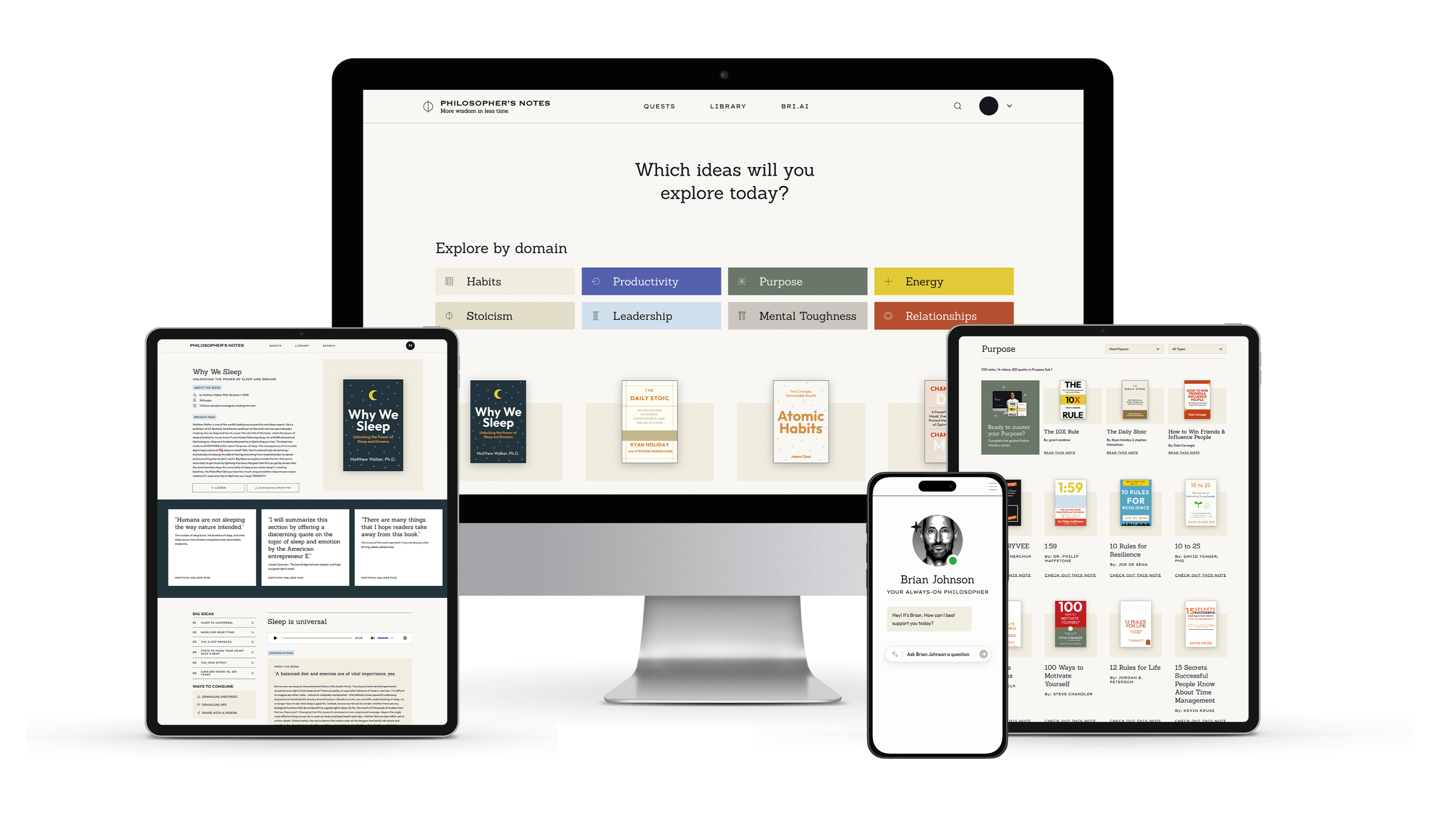
Get all 700+ notes and 101 masterclasses.
Master the Big Ideas from the best books in under 20 minutes a day for one lifetime payment of $99.