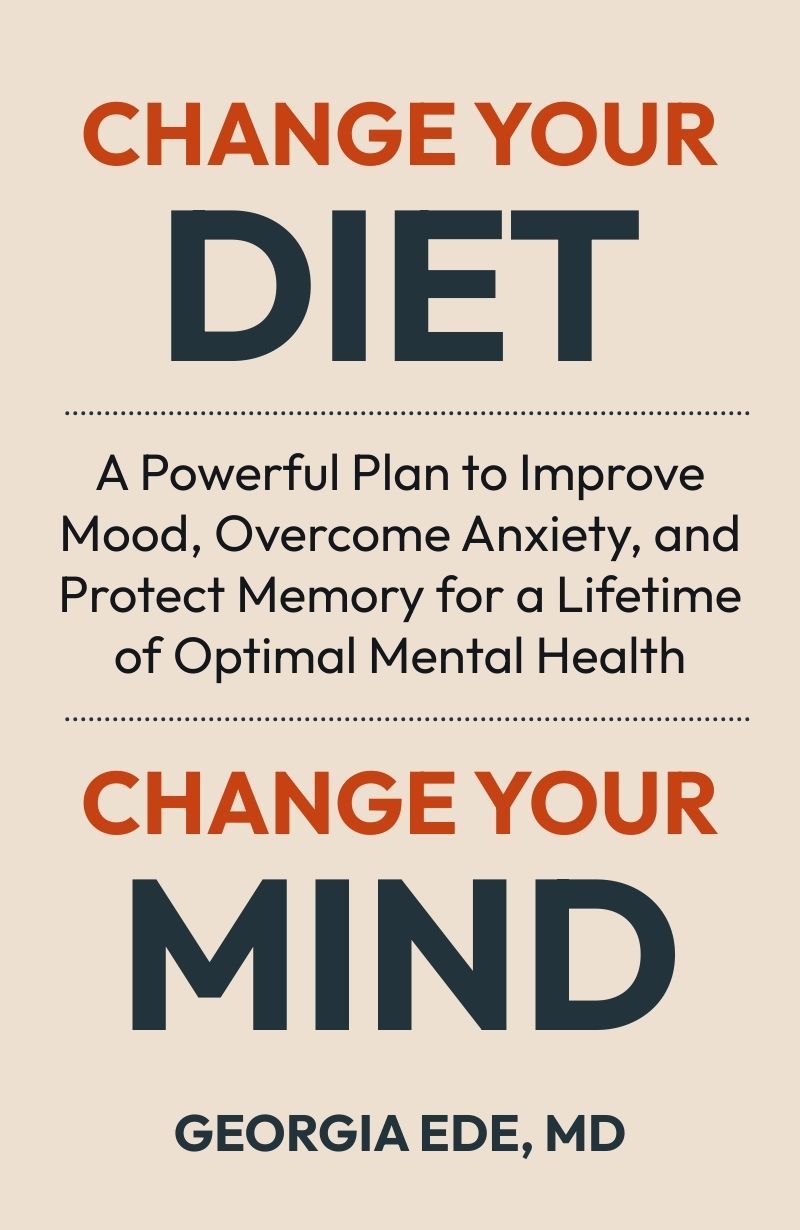
Change Your Diet, Change Your Mind
A Powerful Plan to Improve Mood, Overcome Anxiety, and Protect Memory for a Lifetime of Optimal Mental Health
About the book
 |
by Georgia Ede, MD | Balance ©2024 |
 |
464 pages |
 |
7 hours saved on average by reading this note |
brian’s take
Dr. Georgia Ede is a Harvard-trained psychiatrist specializing in the fascinating intersection of nutrition science, brain metabolism, and mental health. With over two decades of clinical experience, including groundbreaking work at Smith College and Harvard University Health Services, she was the first to offer nutrition-based therapies as an alternative to psychiatric medications. I came across this incredible book after Alexandra interviewed Dr. Ede for one of her Luminary Sessions with Heroic Coaches. This book is PACKED with Big Ideas to help you and your family conquer mental health challenges. I’m excited to share some of my favorites, so let’s jump straight in!
"The single most important change you can make to your diet to protect your brain from damaging inflammation and oxidative stress is to avoid refined carbohydrates and vegetable oils, which starts with eliminating ultra processed foods."
Georgia Ede, MD
big ideas
01 |
What causes mental health problems? |
02 |
what is a brain-healthy diet? |
03 |
meat: the original "superfood" |
04 |
grains, beans, nuts & seeds: consumer beware |
05 |
quiet carnivore: the ultimate elimination diet |
join today To Access
 |
DOWNLOAD AND PRINT |
 |
LISTEN TO AUDIO |
Change Your Diet, Change Your Mind
introduction
from the book
“What I discovered was that nearly everything I thought I’d known about nutrition was wrong.
I was genuinely shocked to learn that there is absolutely no science (or logic) behind recommendations to eat plant-based diets, balanced diets, high-fiber diets, low-cholesterol diets, or diets containing whole grains, low-fat dairy products, or rainbows of fruits and vegetables. At best, these ideas represent well-intentioned guesses based on deeply flawed, unscientific food questionnaires; at worst, they are intentional distortions of the facts designed to protect professional reputations or serve political and commercial agendas, not to protect and serve public health.
The truth about nutrition is this: Meat is not dangerous, vegan diets are not healthier, and antioxidants are not the answer. So, where can we look for answers?
The good news is that hiding underneath that mountain of biased, confusing guesswork are clear, elegant, compelling scientific principles about nutrition that make intuitive sense, work in clinical practice, and stand the test of time. Do we know everything we wish we knew? No. Do we know more than enough for you to substantially improve your brain health starting today? Absolutely.
Most of us have been feeding our brains improperly our entire lives, therefore we have no idea how much better we can feel and how much more we can expect of ourselves if we eat right. …
I believe that many of the emotional and cognitive issues we have come to expect as normal, genetic, or permanent can be prevented, eased, or even reversed with good nutrition. … My goal in writing this book was to take the confusion out of nutrition and replace it with science, simplicity, and common sense; to teach you how to think for yourself about food so you can make your own informed choices and find what works best for you and your family.”
Dr. Georgia Ede is a Harvard-trained psychiatrist specializing in nutrition science, brain metabolism, and mental health.
Her two decades of clinical experience include twelve years at Smith College and Harvard University Health Services, where she was the first to offer nutrition-based therapies as an alternative for psychiatric medications.
I got this book after Alexandra picked it up and interviewed Dr. Ede for one of her Luminary Sessions for our Heroic Coaches. (We’ve made it available for everyone here. Join Heroic Coach to see 100+ other sessions like that along with everything else that goes into the program.)
For the record: This book is now my ALL-TIME favorite nutrition book. The last time I said that was with Chris Palmer’s fantastic book: Brain Energy.
Both of them BRILLIANTLY connect the health of our mitochondria and overall metabolism to our PSYCHOLOGICAL well-being and are leading thinkers and practitioners in the nascent field of nutritional psychiatry.
With over 1 BILLION PEOPLE suffering from anxiety, depression, and other mental health challenges (including you or someone you love?), we’ve never needed more powerful tools to address the crisis than RIGHT NOW. And, as I’ve been saying for YEARS, our PHYSIOLOGY drives a LOT MORE of our PSYCHOLOGY than most of us (and our physicians) are aware.
This book provides an incredibly powerful perspective that I am VERY (!!!) confident can help you and your family conquer any challenges you may be facing. It’s not possible for me to recommend it any higher. Get a copy here today.
This book is PACKED with Big Ideas. We’ll barely scratch the surface. But I’m excited to share some of my favorites, so let’s jump straight in!
P.S. Before we get to work, I want to take a moment to highlight some wisdom from Dr. Ede: “Please, do not change your medication without professional guidance and never stop any psychiatric medication abruptly.”
P.P.S. One more quick thought from Dr. Ede: “It breaks my heart to see people struggling with mental health problems who have tried a dozen or more medications or years of psychotherapy but have never tried changing their diet in any way. Or worse yet, to see people faithfully following what they’ve been told is a brain-healthy diet of whole grains, legumes, nonfat dairy, blueberries, dark chocolate, and red wine yet continue to feel depressed, confused, anxious, or unstable—believing they are already doing all they can, when there is SO much more they can do. Whether you are dealing with a serious mental illness like schizophrenia, or an everyday mental health concern like irritability, I want you to know there is hope. Changing your mind with diet requires changing your mind about diet.”
What causes mental health problems?
from the book
“We’re in the midst of a global mental health crisis.
Nearly one billion people are living with a mental health disorder, including one in five of the world’s children and adolescents. Every year, 700,000 people take their own lives, and suicide is now the second leading cause of death among people in their teens and twenties. Depression and anxiety alone cost the global economy nearly three billion dollars a day. And these numbers don’t include the countless people with milder health concerns like brain fog, irritability, and joylessness. Psychiatric problems of all kinds are becoming so commonplace that we are beginning to think of poor mental health as normal and inevitable. …
If you are a fellow mental health professional, you don’t need statistics to tell you how challenging things have become. Everywhere I’ve worked—clinics, hospitals, universities—I’ve encountered the same issues: Practitioners overwhelmed by large, complex caseloads, and patients frustrated with wait times that are too long for appointments, and training peer counselors, but there never seems to be enough time or resources to meet the growing needs of the people we are trying to serve. Meanwhile, everyone is working so hard that there’s no time to stop and ask: Why is our mental health deteriorating? Is there anything we can do about it, or do we simply accept it as inevitable?
If we are to have any hope of reversing this tragic trend, we need a better understanding of the root causes of psychiatric disorders.”
Those are the first words of the first chapter: “What Causes Mental Health Problems?”
Before we get to the answer to that question, let’s take another moment to reflect on the scale of the crisis we face. Nearly ONE BILLION PEOPLE are living with a mental health disorder. One in five of the world’s children and adolescents. And countless more suffer from brain fog, irritability, and joylessness.
Let that sink in for a moment.
If you haven’t personally experienced your own mental health challenge and/or watched a loved one suffer, you would be in a VERY SMALL minority of human beings on the planet.
After establishing the sobering statistics, Dr. Ede tells us that the current approaches to solving the challenges aren’t working. She says:“I value modern talk therapy and have been incorporating it into my clinical work for more than twenty years, but I have yet to see psychotherapy alone put any case of serious mental illness into remission.”
Then she walks us through the fact that a healthy mind lives in a healthy body and tells us: “Medications can and do change brain chemistry, and they have their place, but I’m convinced that the most powerful way to change brain chemistry is through food, because that’s where brain chemicals come from in the first place.”
Then she introduces us to the emerging field of nutritional psychiatry: “The relatively new specialty of nutritional psychiatry was established on the belief that the deterioration in the quality of our diet is mostly to blame for the deterioration in our mental health.”
With that, it’s time to get to work on changing our diets so we can change our minds.
what is a brain-healthy diet?
from the book
“I propose that for any dietary pattern to be considered brain-healthy, it must fulfill all three of the following criteria:
1. It must NOURISH the brain by including adequate amounts of all essential nutrients.
2. It must PROTECT the brain by excluding damaging ingredients.
3. It must ENERGIZE the brain in ways that support healthy metabolism for a lifetime by keeping blood sugar and insulin levels in a healthy range.
These are the principles I used to create the dietary strategies I share with you in this book, and these very same principles apply to the rest of the body as well. All of our cells require the same nutritional care, which is fortunate, as eating a different diet for every organ we possess would be inconvenient, to say the least.”
That’s from the second chapter called “The New Science of Hope” in which Dr. Ede gives us the high-level framework for her approach.
In the final section of the book called “Hope Is on the Menu,” she walks us through her “Quiet Diet Approach” and says: “We’ve been fed the wrong information on nutrition for generations, which means that, if you’re like most of us, you’ve been feeding your brain improperly all your life. The silver lining around this cloud is that you have no idea how much better you could feel if you ate a brain-healthy diet. Get curious! You owe it to yourself to discover what’s possible. Your outlook on life could change in ways you wouldn’t have imagined.”
Note: When I read that, I thought of wisdom from Peter Attia’s Outlive where he talks about “baseline resetting.” Most people have been so chronically sub-optimal for so long that they don’t even realize just how bad they feel. It’s like having an old-school color TV and thinking that’s just how great it gets then getting a fancy new HD TV and realizing just how flat your life was.
Dr. Ede continues by saying: “Which dietary changes are most worth making, and why? Let’s return to our touchstones of nourish, protect, and energize and create a fresh new set of brain rules grounded in biology instead of ideology, questionnaire-based guesswork, or wishful thinking. A brain-healthy diet must:
Nourish the brain by providing all the essential nutrients. Include animal foods because they are nutrient-rich. Avoid plant foods high in antinutrients, especially grains and legumes.
Protect the brain by excluding foods that contain damaging ingredients. Follow whole-foods principles. Avoid refined carbohydrates, vegetable oils, and alcohol because they cause inflammation and oxidative stress. Avoid high-toxin plant foods such as cassava, flaxseed, and most nightshades. Consider eliminating all dairy products. Listen to your body. Limit any food that causes you physical or psychological side effects such as digestive distress, insomnia, fatigue, or brain fog, as symptoms such as these may indicate inflammation.
Energize the brain in ways that protect brain metabolism over the life span by keeping blood glucose and insulin levels in a healthy range. Avoid refined carbohydrates. Avoid dairy protein powders. Customize carbohydrate quantity to achieve healthy glucose and insulin levels.”
Those are Dr. Ede’s three food rules. I repeat: If we want to change our diet to change our minds, we need to make sure we are NOURISHING, PROTECTING, and ENERGIZING our brain.
Get the book for the full details on her Quiet Paleo, Quiet Keto, and Quiet Carnivore approaches. For now, let’s take a quick look at a few other practical Ideas.
meat: the original "superfood"
from the book
“Meat is good for you.
These five words represent a simple statement of biological fact. While there remain some unanswered questions about nutrition, the question of whether animal foods belong in the human diet is not one of them. Meat provides all the macronutrients and micronutrients we need, in their proper forms—including some that are difficult or impossible to obtain from plant foods. Unlike plant foods, meat contains no substances that interfere with our ability to absorb or utilize nutrients. Meat is easy to digest and supports healthy insulin levels without promoting blood glucose spikes. The human brain evolved to require animal-source foods and therefore cannot develop or function properly without them.
In a perfect world, this would be all anyone needs to know about meat—but given the widespread efforts to blame meat for everything from constipation to cardiovascular disease to cancer, it is not enough to explain the biological benefits of meat—especially red meat—can harm us or even kill us demand our attention, therefore I devote the lion’s share of this chapter to the dismantling of popular anti-meat arguments so that you can see them for the paper tigers they are. All that said, we cannot turn a blind eye to the harsh realities of industrialized meat production systems. While I am convinced by the science that meat belongs in a brain-healthy diet, I am equally convinced that the way many animal foods are produced is inhumane and unhealthy for animals, humans, and the planet, so we will wrestle with these problems as well, in search of a better way forward.”
That’s from the first chapter in Part 3 in which Dr. Ede walks us through “The Whole Truth About Whole Foods.” The chapter is called: “Meat: The Original ‘Superfood.’”
The last Note I worked on was Gabrielle Lyon’s Forever Strong. That book is all about the importance of skeletal muscle for our energy and longevity. She says EXACTLY the same thing.
Here’s how she puts it: “No one can accurately argue with the fact that animal products provide higher-quality protein. ... Red meat is as old-school as it gets—the highest source of bioavailable proteins and amino acids—it’s the OG of superfoods.”
Now, I realize that talking about meat is a sensitive subject for a lot of us. As I said in my Notes on Forever Strong, I was vegan for over a decade. And, I was one of those super-annoying, self-righteous, vegangelical fundamentalists who WAS CERTAIN I was right and all that. (Hah. Not hard to imagine, eh? Laughing.)
And... Although I don’t miss the migraines and fluctuating energy and mood levels along with the bloating from those days, I’m committed to NOT being dogmatic about ANY nutritional philosophy EVER again. So... I won’t say much more in this context other than this...
If you’re plant-based and you feel GREAT (!), awesome. If you’re plant-based and you’re NOT feeling great, I encourage you to consider being open to other perspectives that may help you get your Energy optimized so you can most fully give yourself to the world.
grains, beans, nuts & seeds: consumer beware
from the book
“We think of grains, beans, nuts, and seeds as unrelated, but crack any of them open and you’ll find a tiny embryo crouched inside. Even though we only use the word ‘seed’ for one branch of this family, deep down, all of these foods are seeds.
Grains are the seeds of grasses (wheat, corn, rice, oats, etc.)
Beans are the seeds of legumes (peas, soybeans, lentils, etc.)
Nuts are the seeds of trees (almonds, walnuts, pistachios, etc.)
‘Seeds’ are (mostly) the seeds of flowers (sunflower seeds, poppy seeds, sesame seeds, etc.)
To avoid confusion, we’ll use ‘seed foods’ as an umbrella term to refer to all grains, beans, nuts, and seeds.
Just as dairy products are the most complicated animal foods on Earth, seed foods are the most complicated plant foods on Earth. Protecting and nurturing the future generations of one’s species is no easy task, and these weighty responsibilities are what make these simultaneously the most nutritious and most problematic plant foods you can eat. Avoiding the seed food family is one of the most important things you can do to protect your brain and overall health.”
That’s from a chapter called “Grains, Beans, Nuts, and Seeds: Consumer Beware.”
I’m going to repeat that last line: “Avoiding the seed food family is one of the most important things you can do to protect your brain and overall health.”
Personal question time... How many “seed family” foods are YOU (and YOUR KIDS!) eating these days? You open to the possibility that might not be a wise staple to your diet?
As you consider that, consider this: “I realize it’s hard to imagine life without seed foods—particularly grains, which most of us have been eating multiple times a day since early childhood—but the health benefits for your brain and the rest of your body are well worth it. I recognize that my recommendation that you remove grains and legumes from your diet may come across as radical and risky, flying in the face of decades of global health policy and thousands of years of human history.
Grains and legumes are trusted and beloved by cultures in all four corners of the globe. Countless people around the world live with food insecurity and depend on starchy grains and legumes for their survival. Wheat, rice, and maize together comprise 60 percent of the world’s caloric intake—in some regions by choice, in others by necessity. However, it is important to make a distinction between dietary strategies that ensure the survival of large populations and dietary strategies that optimize the health of your brain and the rest of your body. If you are seeking better mental and physical health, eliminating grains and legumes is the single most important change you can make to your whole-foods diet.”
And... I’m going to repeat that last line as well: “If you are seeking better mental and physical health, eliminating grains and legumes is the single most important change you can make to your whole-foods diet.”
quiet carnivore: the ultimate elimination diet
from the book
“If Quiet Paleo or Quiet Keto didn’t bring you the benefits you’d hope for, you may benefit from a carnivore diet, at least as a short-term experiment.
… At first glance, carnivore diets may seem extreme, irrational, and dangerous. However, when we look objectively at the biological differences between plant and animal foods, it becomes easier to appreciate the potential health benefits of these unorthodox ways of eating.
Plant-free diets efficiently eliminate multiple culprits all at once—grains, legumes, sugar, starch, fiber, all plant toxins, and nearly all antinutrients. … Plants are hard on the body, so excluding all plant foods, at least for a while, may offer unique therapeutic advantages—particularly for those of us with compromised defenses who have lost the ability to safely and comfortably tolerate a wide variety of plant foods. I have found carnivore diets to be indispensable discovery tools in my clinical practice not only for identifying food sensitivities, but for resolving chronic constipation and IBS symptoms, quieting food addiction and binge eating, and breaking weight loss plateaus. The simplicity of carnivore diets is also wonderful for people who want to get into ketosis but feel too depressed or overwhelmed to memorize food lists, or count carbohydrates.”
That’s from one of the last chapters in the book. After Dr. Ede walks us through her “Quiet Paleo” and “Quiet Keto” approaches, she talks about “Quiet Carnivore.”
Now... It’s time for a fun fact! Here it is: I’ve been personally experimenting with carnivore for about four years now. I’ve never mentioned it publicly until now because I like to stay out of the religious food wars and focus on our Heroic Food Rules and, well, I think it’s CRAZY. (Hah.)
I can still vividly remember when Alexandra first told me about people going carnivore nearly five years ago. I told her that I thought it was THE STUPIDEST THING I’D EVER HEARD. Seriously. Eat nothing but meat? That’s CRAZY.
Note: I had almost the EXACT same reaction when she read It Starts with Food right before we had Emerson and she suggested we go from being vegan to Paleo. I thought that was THE STUPIDEST IDEA she’d ever had. (Hah!) Then I tested it. And... My migraines disappeared along with some weird bumps I had on my arms along with the bloated belly I had that made skinny-me look like I was more pregnant than her.
Now... To be clear... I STILL THINK CARNIVORE IS CRAZY. (Note: Jordan Peterson articulates my experience brilliantly in this interview with Peter Attia.) But... It’s not possible for me to articulate JUST how much better I feel when I follow a carnivore-ish diet. The energized tranquility, calm confidence, mental clarity, and stable mood and energy is astonishing.
Having said that, here’s to making ALL of life an experiment so we can activate our Heroic potential and give the world all we’ve got... All day, every day, especially... TODAY!