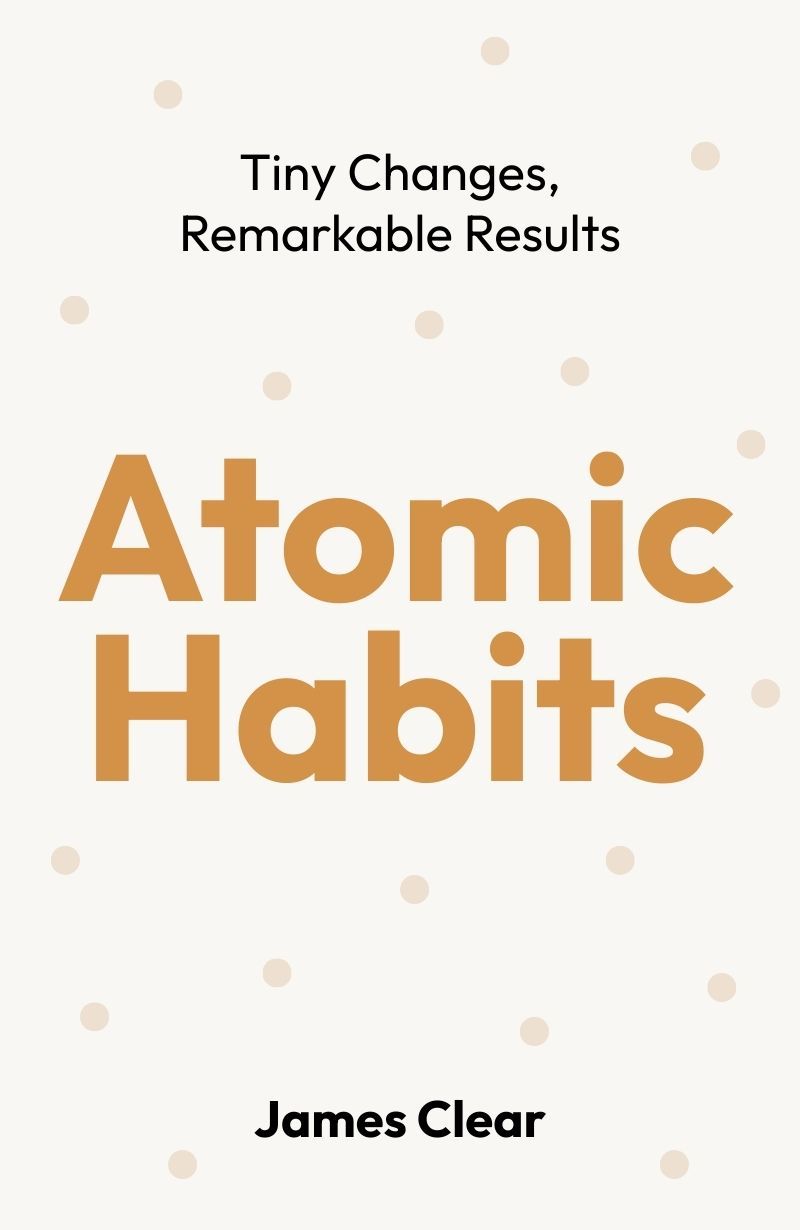
Atomic Habits
An Easy & Proven Way to Build Good Habits & Break Bad Ones
About the book
 |
by James Clear | Lioncrest Publishing © 2017 |
 |
320 pages |
 |
7 hours saved on average by reading this note |
brian’s take
Big Ideas we explore include: The math behind 1% gains compounding over a year (and a decade!), navigating the Plateau of Latent Potential (ever given up on a habit? Take note!), the importance (and etymology) of our Identity (get this: it *literally* means 'repeated being ness'), The 4 Laws of Behavior Change (remember: cue + craving + response + reward and... make it obvious, make it attractive, make it easy, make it satisfying), and the Sorites Paradox (can a single habit change your life?).
"The only way to become excellent is to be endlessly fascinated by doing the same thing over and over. You have to fall in love with boredom."
James Clear
big ideas
01 |
Why tiny changes lead to remarkable results |
02 |
The plateau of latent potential |
03 |
Identity |
04 |
The 4 Laws of behavior Change |
05 |
The sorites Paradox |
join today To Access
 |
DOWNLOAD AND PRINT |
 |
LISTEN TO AUDIO |
Atomic Habits
introduction
from the book
“If you’re having trouble changing your habits, the problem isn’t you. The problem is your system.
Bad habits repeat themselves again and again not because you don’t want to change, but because you have the wrong system for change.
You do not rise to the level of your goals. You fall to the level of your systems.
Focusing on the overall system, rather than a single goal, is one of the core themes of this book. It is also one of the deeper meanings behind the word atomic. By now, you’ve probably realized than an atomic habit refers to a tiny change, a marginal gain, a 1 percent improvement. But atomic habits are not just any old habits, however small. They are little habits that are part of a larger system. Just as atoms are the building blocks of molecules, atomic habits are the building blocks of remarkable results.
Habits are like the atoms of our lives. Each one is a fundamental unit that contributes to your overall improvement. At first, these tiny routines seem insignificant, but soon they build on each other and fuel bigger wins that multiply to a degree that far outweighs the cost of their initial investment. They are both small and mighty. This is the meaning of the phrase atomic habits—a regular practice or routine that is not only small and easy to do, but also the source of incredible power; a component of the system of compound growth.”
James Clear has a super-popular website (jamesclear.com). Millions of people visit it every month and hundreds of thousands subscribe to his email newsletter.
After reading this book, I can see why.
He’s a great writer and distills the essence of habit formation into, well, its fundamental components—the “atomic” structure if you will—while showing us how those TINY little incremental improvements add up to MIGHTY results. (We’ll talk about the math behind +1% daily gains in our first Big Idea.)
Now, I rarely say a book is a must-read but this one’s as close as it gets.
We’ve covered a lot of books on habits, but I’d say THIS book is the one to read for the best scientific overview of how habits work AND the best practical model to make that science work for you. I think you’ll love it. Get a copy here.
The book is PACKED (!!!) with Big Ideas. It’s one of those books that is SO GOOD it’s really hard to distill into a six-page Note. We’ll barely scratch the surface of all the goodness, but I’m excited to share some of my favorites so let’s jump straight in!
Why tiny changes lead to remarkable results
from the book
“It is so easy to overestimate the importance of one defining moment and underestimate the value of making small improvements on a daily basis.
Too often, we convince ourselves that massive success requires massive action. Whether it is losing weight, building a business, writing a book, winning a championship, or achieving any other goal, we put pressure on ourselves to make some earth-shattering improvement that everyone will talk about.
Meanwhile, improving 1 percent isn’t particularly notable—sometimes it isn’t even noticeable—but it can be far more meaningful, especially in the long run. The difference a tiny improvement can make over time is astounding. Here’s how the math works out: if you can get 1 percent better each day for one year, you’ll end up thirty-seven times better by the time you’re done. Conversely, if you get 1 percent worse each day for one year, you’ll decline nearly down to zero. What starts as a small win or a minor setback accumulates into something much more.
Habits are the compound interest of self-improvement. The same way that money multiplies through compound interest, the effects of your habits multiply as you repeat them. They seem to make little difference on any given day and yet the impact they deliver over the months and years can be enormous. It is only when looking back two, five, or perhaps ten years later that the value of good habits and the cost of bad ones becomes strikingly apparent.”
That’s from Part I: The Fundamentals, Chapter 1: The Surprising Power of Atomic Habits.
James kicks the book off with the story about Brailsford and his astonishing turnaround of the British cycling team via marginal gains. Moral of that story: Little things matter. A lot.
We talk a lot about Optimizing just a little more every day, aggregating and compounding those tiny little gains over an extended period of time. Now, we have the math for what happens when we get just 1% (!) better every day for a year. We’re 37 (!!!) times better.
But get this. Create a spreadsheet (like this) and run that 1% daily improvement out for another year. Guess what? After two years, you’re not 74 times better. You’re now 1,400 (!!) times better.
Why stop there? Run it out another year. After the third year of aggregating and compounding those 1% gains, you’re now 53,405 times better. Four years? You’re 2,017,828 times better. Five years? You’re 76,240,507 times better.
Shall we run it 10 years out? OK. Let’s. Result: Well, on day 3,472 we hit our last normal number. We’re 998,822,690,009,590 times better. (That’s nearly a quadrillion times better by the way.) Then we break our Google Spreadsheet by day 3,650 when we’re at 5.87074E+15. I don’t even know what that means but I assume it’s even more zeroes. lol.
All that to say: Little things matter. A lot. Especially when we compound them over time.
Of course, those numbers get absurd quickly. But… THAT’S THE WHOLE POINT!! (Laughing.)
Harvard Professor (of the Psychology of Possibility) Ellen Langer comes to mind. She tells us that our potential is UNKNOWABLE. Literally. It’s impossible to know what we’re capable of until we actually let go of the limits. And start doing the little things. Consistently.
Ralph Waldo Emerson comes to mind as well. In Self-Reliance, he has a great line about the fact that great human beings have an aura about them. He says that it’s almost as if they have a train of angels escorting them. (Perhaps that’s what the “E+15” means in our math above. :)
As he puts it: “The force of character is cumulative. All the foregone days of virtue work their health into this. What makes the majesty of the heroes of the senate and the field, which so fills the imagination? The consciousness of a train of great days and victories behind. They shed an united light on the advancing actor. He is attended as by a visible escort of angels.”
P.S. Here’s another way James puts it: Imagine a plane taking off from LAX. The desired destination is New York City. But… If the nose of the plane is pointed just 3.5 degrees south and the pilots don’t correct for it, they’ll land in Washington D.C. rather than NYC. 90 inches off at the start equals hundreds of miles off at the end. Again, little things matter. A lot.
P.P.S. One very important thing to remember. Compounding is magic. AND… Although we’ll never be perfect, to see the benefits we need to make sure we don’t give back our gains.
The plateau of latent potential
from the book
“If you find yourself struggling to build a good habit or break a bad one, it is not because you have lost your ability to improve. It is often because you have not yet crossed the Plateau of Latent Potential.
Complaining about not achieving success despite working hard is like complaining about an ice cube not melting when you heated it from twenty-five to thirty-one degrees. Your work was not wasted; it is just being stored. All the action happens at thirty-two degrees. When you finally break through the Plateau of Latent Potential, people will call it an overnight success. …
Mastery requires patience. The San Antonio Spurs, one of the most successful teams in NBA history, have a quote from social reformer Jacob Riis hanging in their locker room: ‘When nothing seems to help, I go and look at a stonecutter hammering away at his rock, perhaps a hundred times without as much as a crack showing in it. Yet at the hundred and first blow it will split in two, and I know it was not that last blow that did it—but all that had gone before.’”
We’re still in the first chapter on the surprising power of atomic habits. ← Little things add up to big things. Got it.
The problem is that it takes TIME for those little things to add up to those big things. Unfortunately, too often we want our lives to change x days after starting the new diet or fitness program or whatever. And, when the results don’t IMMEDIATELY show up, we stop doing the little things that would have led to the success we’re after.
That gap between our effort and results? James calls it the “Plateau of Latent Potential” and tells us: “It’s a hallmark of any compounding process: the most powerful outcomes are delayed.”
Darren Hardy wrote a whole book on a similar theme called The Compound Effect. Remember our doubling penny? The magic doesn’t REALLY start until we’re pretty far into the process.
Jeff Olson wrote a book called The Slight Edge all about doing the little things consistently as well. He tells us that people want to go from “plant to harvest” without “cultivating.” He says: “Plant, cultivate, harvest. And that second comma, the one between cultivate and harvest, often represents a loooong period of time.”
How about you? Have you (like every other human on the planet!) ever bailed during the “Plateau of Latent Potential” phase—before we got to see the true value you were building?
Remember the stonecutter. And the melting ice cube. All that energy put in before we get the big results? KNOW the DELAY is an essential part of the process.
Identity
from the book
“Identity change is the North Star of habit change. The remainder of this book will provide you with step-by-step instructions on how to build better habits for yourself, your family, your team, your company, and anywhere else you wish.
But the true question is: ‘Are you becoming the type of person you want to become?’ The first step is not what or how, but who. You need to know who you want to be. Otherwise, your quest for change is like a boat without a rudder. And that’s why we’re starting here.
You have the power to change your beliefs about yourself. Your identity is not set in stone. You have a choice in every moment. You can choose the identity you want to reinforce today with habits you choose today. And this brings us to the deeper purpose of this book and the real reason habits matter.
Building better habits isn’t about littering your day with life hacks. It’s not about flossing one tooth each night or taking a cold shower each morning or wearing the same outfit each day. It’s not about achieving external measures of success like earning more money, losing weight, or reducing stress. Habits can help you achieve all of these things, but fundamentally they are not about having something. They are about becoming someone.
Ultimately, your habits matter because they help you become the type of person you wish to be. They are the channel through which you develop your deepest beliefs about yourself. Quite literally, you become your habits.”
Welcome to Chapter #2: How Your Habits Shape Your Identity (and Vice Versa).
That chapter comes right before we are introduced to the four “laws” of habits. But, before we learn the what and the how we need to start with the WHO.
Specifically: WHO DO YOU WANT TO BECOME?! ← THAT is the ultimate driver for our habits.
So, before we go any further… WHO DO YOU WANT TO BECOME?!
A healthy/fit athlete? A super-productive person? A great husband/wife/mother/father?
As you contemplate that, contemplate this: “The more you repeat a behavior, the more you reinforce the identity associated with that behavior. In fact, the word identity was originally derived from the Latin word essentitas, which means being, and identidem, which means repeatedly. Your identity is literally your “repeated beingness.’”
← Wow. Your identity is LITERALLY your “repeated beingness.” ← That’s beautiful.
And, your identity, as James tells us, emerges from your HABITS: “Whatever your identity is right now, you only believe it because you have proof of it.”
Therefore… Want a new identity? Repeat the desired behavior as frequently as possible. And… Want to repeat the desired behavior as frequently as possible, live from your new identity.
There’s so much in this chapter that’s worth highlighting it’s almost absurd. Although the rest of the book is equally good, the book is worth it for this section alone. Get the book for more.
For now, imagine the optimus you. Go be that.
P.S. Remember: “That’s like me!” and The As If Principle! (And Self-Image 101.)
The 4 Laws of behavior Change
from the book
“If a behavior is insufficient in any of the four stages, it will not become a habit.
Eliminate the cue and your habit will never start. Reduce the craving and you won’t experience enough motivation to act. Make the behavior difficult and you won’t be able to do it. And if the reward fails to satisfy your desire, then you’ll have no reason to do it again in the future. Without the first three steps, a behavior will not occur. Without all four, a behavior will not be repeated.
In summary, the cue triggers a craving, which motivates a response, which provides a reward, which satisfies the craving and, ultimately, becomes associated with the cue. Together, these four steps form a neurological feedback loop—cue, craving, response, reward; cue, craving, response, reward—that ultimately allows you to create automatic habits. This cycle is known as the habit loop.”
Welcome to Chapter #3: How to Build Better Habits in 4 Simple Steps.
The 4 steps form the “habit loop” and the basis for the 4 Laws of Behavior Change. They are (once again): Cue + Craving + Response + Reward. We have a cue in our environment that leads to a desire to do something, we respond and we get a reward. Repeat.
(This is very similar to Charles Duhigg’s model from The Power of Habit. James tells us he sees his work as building on Duhigg’s. I agree. It’s a nice, super-practical extension.)
Here’s the quick look at the 4 Laws of Behavior Change that are driven by those steps:
The 1st law (Cue)
How to Create a Good Habit: Make it obvious.
How to Break a Bad Habit: Make it invisible.
The 2nd law (Craving)
How to Create a Good Habit: Make it obvious.
How to Break a Bad Habit: Make it unattractive.
The 3rd law (Response)
How to Create a Good Habit: Make it easy.
How to Break a Bad Habit: Make it difficult.
The 4th law (Reward)
How to Create a Good Habit: Make it satisfying.
How to Break a Bad Habit: Make it unsatisfying.
Each of those 4 Laws gets its own section in the book with really-well organized sub-chapters that help us figure out how to actually apply the wisdom to our lives. Again (echo!), check out the book for the details. For now, let’s take a SUPER quick look at how we’d build a habit.
Let’s say we want to… hmmmm… meditate first thing in the morning.
Law #1: Make it obvious. James tells us we can use implementation intentions such as, “I will meditate first thing in the morning in my bedroom.” (Note: When and where are super important. Be precise and increase the odds of crushing it.) You can also make the cue obvious by “designing your environment.” Perhaps you could put the cushion you’ll sit on in your way from your bed to your bathroom so you trip over it. That’s “obvious.” (Or, if you want to work out, put your gym clothes in the same spot, etc.)
Law #2: Make it attractive. Think about all the research demonstrating the benefits you want—a calm mind, etc. You can also pair it with something you really enjoy doing like drinking a cup of tea or coffee AFTER you meditate. Another good way: “Join a culture where your desired behavior is the normal behavior.”
Law #3: Make it easy. Easiest way to make it easy? “Downscale your habits until they can be done in two minutes or less.” (Think silly-small Mini Habits.) We also want to “Master the decisive moment. Optimize the small choices that deliver outsized impact.” (Think winning fight-thrus a la Organize Tomorrow Today.)
Law #4: Make it satisfying. Give yourself an immediate reward after doing your new habit. James also tells us to never miss twice—very much like the idea of “Habit suicide” we discussed in Superhuman by Habit. And, he recommends: “Use a habit tracker. Keep track of your habit streak and ‘don’t break the chain.’” ← For me, once I committed to meditating daily, in addition to the benefits of a calmer mind I started experiencing (after the Plateau of Latent Potential, btw!), I LOVED my streak. I’m now over 10 years in and I’ve missed one day. Super satisfying.
Insert your desired behavior. Follow the 4 Laws. And… Do the opposite for the stuff you want to get rid of. How about a quick walk through of a bad habit we’d like to break? Eating junk food?!
First: Make it invisible (not obvious). How? Remember to “buy your willpower at the store.” In other words, DON’T BUY JUNK FOOD. (And throw away what you have.) Make it INVISIBLE. (Why? Well, when it’s “obvious”/in sight, what do you do? You eat it!! lol)
Second: Make it unattractive. “Reframe your mind-set. Highlight the benefits of avoiding the bad habits.” For example, imagine your energy stabilizing and your health Optimizing, etc.
Third: Make it difficult. “Increase friction” by increasing the number of steps between you and your bad habits. For example, you need to drive the grocery store to buy the junk food!
Fourth: Make it unsatisfying. Keep that reframe from above in mind and make the connection between your spike/crash energy levels and that junk food!
Your turn! What’s the #1 good habit you’d like to create? #1 bad habit you’d like to break? If you feel so inspired, spend a moment working it through the model!
The sorites Paradox
from the book
“There is an ancient Greek parable known as the Sorites Paradox, which talks about the effect one small action can have when repeated enough times.
One formulation of the paradox goes as follows: Can one coin make a person rich? If you give a person a pile of ten coins, you wouldn’t claim that he or she is rich. But what if you add another? And another? And another? At some point, you will have to admit that no one can be rich unless one coin can make him or her so.
We can say the same thing about habits. Can one tiny change transform your life? It’s unlikely you would say so. But what if you made another? And another? And another? At some point, you will have to admit that your life was transformed by one small change.
The holy grail of habit change is not a single 1 percent improvement but a thousand of them. It’s a bunch of atomic habits stacking up, each one a fundamental unit of the overall system. …
The secret of getting results that last is to never stop making improvements. It’s remarkable what you can build if you just don’t stop. … Small habits don’t add up. They compound. That’s the power of atomic habits. Tiny changes. Remarkable results.”
That’s from the final chapter of the book. First, quick etymology lesson: James tells us that “sorites” is derived from the Greek word for “heap.”
When you give someone a coin that doesn’t make a very big heap. But then you add another. And another. And another. And… At SOME point, that additional coin makes the person wealthy.
And, so it is with our habits. It’s not, as James says, the one 1% improvement. It’s the 1,000.
And… Those improvements don’t just aggregate. They COMPOUND.
And we already know about the power of compounding. Going back to our spreadsheet for a moment. On that 1,000th day, we’re 20,751 times better than we were on day 1.
So, I say, while standing on a soap box shouting (lol): Let’s have fun getting to 10 years and 3,650 1%-gain days en route to being a QUADRILLION times better than our current selves. Then let’s dance with Emerson’s angels as we give ourselves most fully to the world, shall we?!