Big Idea Daily | The Power of Regret
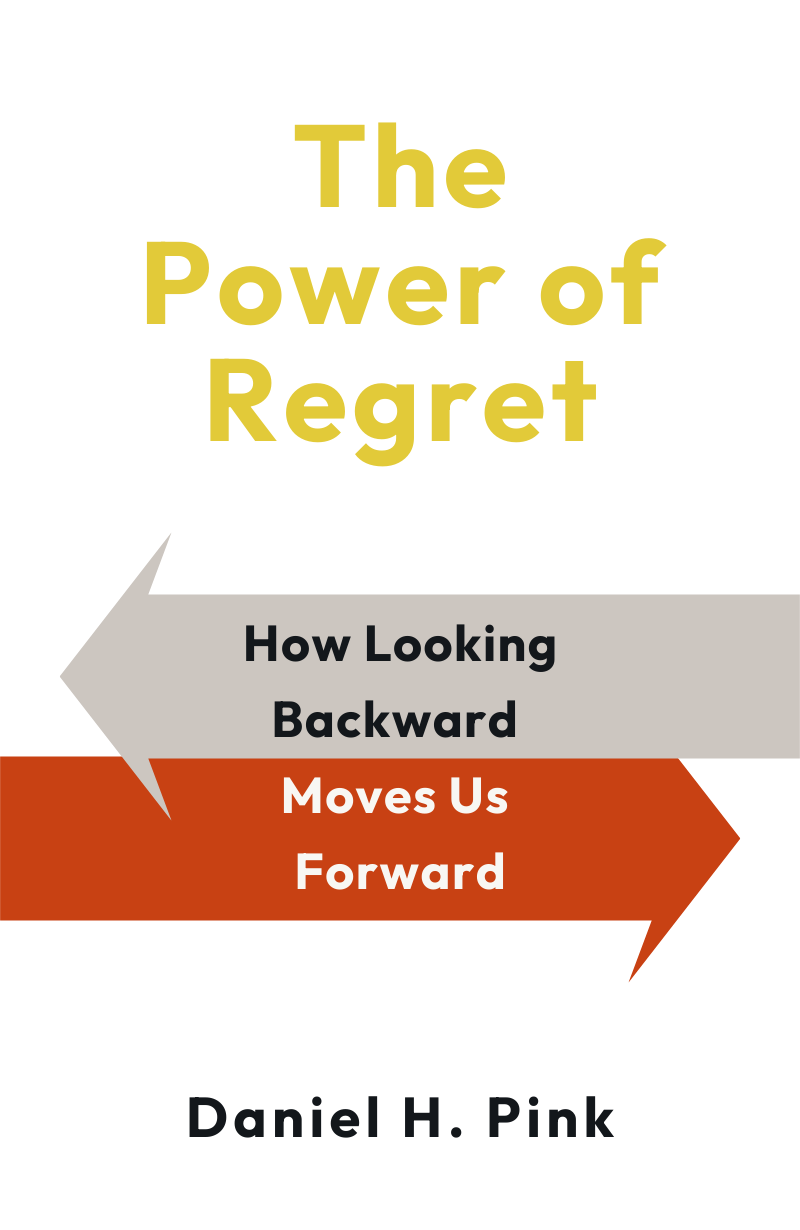 |
How Looking Backward Moves Us Forwardby Daniel H. Pink |
“Nearly all regrets fall into four core categories— foundation regrets, boldness regrets, moral regrets, and connection regrets. This deep structure, previously hidden from view, offers new insights into the human condition as well as a pathway to the good life.”DAN PINK |
BIG IDEA
Regret, the Science and Value Of
FROM THE BOOK“Positive emotions are essential, of course.
We’d be lost without them. It’s important to look on the bright side, to think cheerful thoughts, to detect light in darkness. Optimism is associated with better physical health. Emotions like joy, gratitude, and hope significantly boost our well-being. We need plenty of positive emotions in our portfolio. They should outnumber the negative ones. Yet overweighting our emotional investments with too much positivity brings its own dangers. The imbalance can inhibit learning, stymie growth, and limit our potential.
That’s because negative emotions are essential, too. They help us survive. Fear propels us out of a burning building and makes us step gingerly to avoid a snake. Disgust shields us from poisons and makes us recoil from bad behavior. Anger alerts us to threats and provocations from others and sharpens our sense of right and wrong. Too much negative emotion, of course, is debilitating. But too little is also destructive. A partner takes advantage of us again and again; that snake sinks its teeth into our leg. You and I and our upright, bipedal, large-brained sisters and brothers wouldn’t be here today if we lacked the capacity, occasionally but systematically, to feel bad.
As we assemble the full lineup of negative emotions—sadness standing next to contempt perched beside guilt—one emerges as both the most pervasive and most powerful.
Regret.
The purpose of this book is to reclaim regret as an indispensable emotion—and to show you how to use its many strengths to make better decisions, perform better at work and school, and bring greater meaning to your life.”
|
Brian's Notes
Regret.
Science says: It may not be a fun emotion to feel, but it is an EXTRAORDINARILY powerful and important one.
Another one of the books I read on my mini-sabbatical is called The Upside of Your Dark Side by Todd Kashdan. I’m excited to do a Note on that soon as it’s *all* about the science of embracing the FULL range of your emotional experience.
I’m also excited to share my Notes on Emotional Agility—which also talks about integrating our experience with the FULL range of our emotional experience.
For now, I want to talk about a wonderful passage from another one of Dan’s books: To Sell Is Human. In that book, he talks about the fact that good “sales” people (that would be all of us at one time of the day or another!) are “bouyant”—they have just the right amount of positivity and negativity.
He quotes Barbara Fredrickson to make his point.
As you may know, Barbara LITERALLY wrote the book on “Positivity.” (Note soon!)
She’s the one who established the fact that we need to make sure we have a positive ratio of positive to negative emotions in our lives.
In fact, her ratio is 5:1.
We want to have roughly five positive emotions for every one negative emotion.
But...
And... This is one of those VERY BIG BUTS!
The ratio SHOULD NOT BE, nor should we try to make it something like 500 to 0.
That’s neither possible nor healthy.
Here’s how Dan frames it in To Sell Is Human: “Fredrickson sees the healthy positivity ratios… as a calibration between two competing pulls: levity and gravity. ‘Levity is that unseen force that lifts you skyward, whereas gravity is the opposing force that pulls you earthward. Unchecked levity leaves you flighty, ungrounded, and unreal. Unchecked gravity leaves you collapsed in a heap of misery,’ she writes. ‘Yet when properly combined, these two opposing forces leave you buoyant.’”
Levity + Gravity = Buoyancy.
Integrating both the positive and the negative.
THAT’s what we’re going for.
Big Ideas
01: REGRET
02: FOUR CORE REGRETS
03: SELF-COMPASSION
04: WHAT TO DO
05: REDEMPTION
“Though we would like to live without regrets, and sometimes proudly insist that we have none, this is not really possible, if only because we are mortal.”JAMES BALDWIN |
Get all 700+ notes and 101 masterclasses.
Master the Big Ideas from the best books in under 20 minutes a day for one lifetime payment of $99.