Big Idea Daily | The 4 Disciplines of Execution
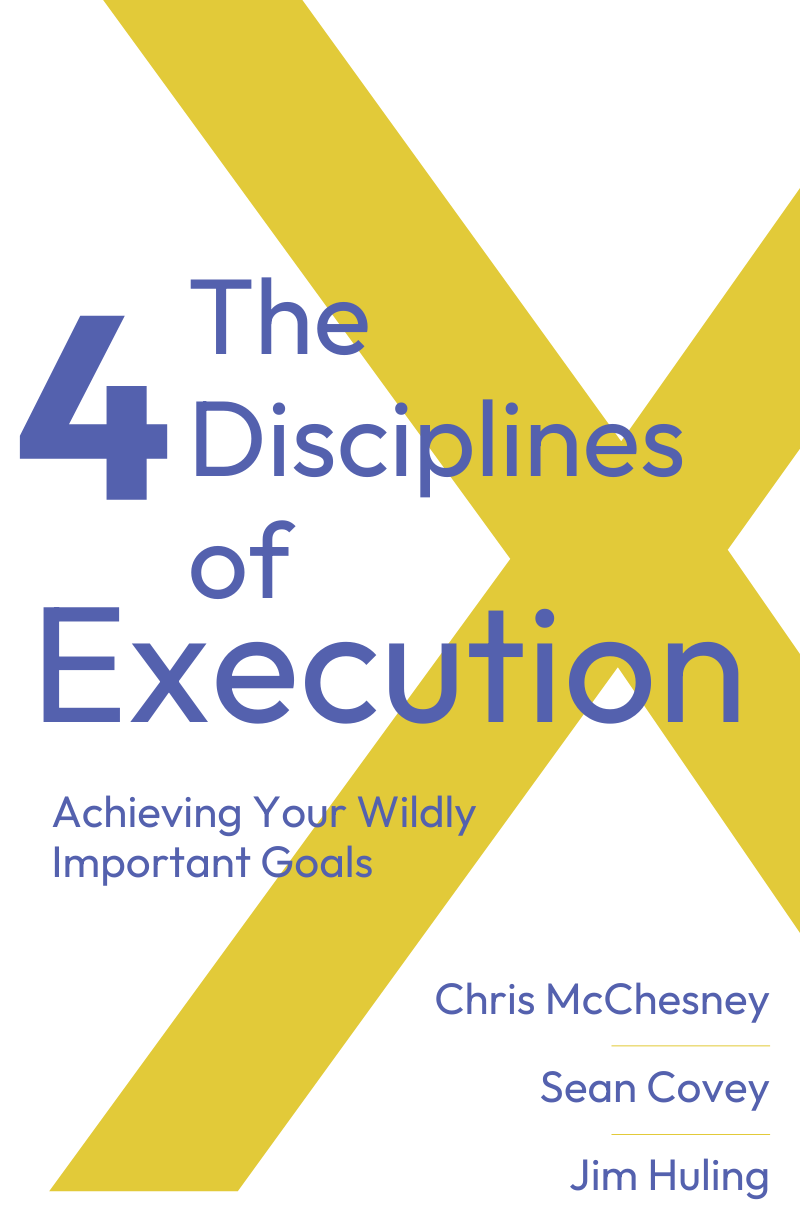 |
Achieving Your Wildly Important Goalsby Chris McChesney |
“We believe all leaders facing this challenge should have this quote prominently displayed in their offices: “There will always be more good ideas than there is capacity to execute.””CHRIS MCCHESNEY, SEAN COVEY, JIM HULING |
BIG IDEA
The 4 Disciplines of Execution
FROM THE BOOK“Although the disciplines may seem simple at first glance, they are not simplistic.
They will profoundly change the way you approach your goals. Once you adopt them, you will never lead in the same way again, whether you are a project coordinator, lead a small sales team, or run a Fortune 500 company. We believe they represent a major breakthrough in how to move teams and organizations forward.
Here’s a quick overview of the 4 Disciplines.
Discipline 1. Focus on the Wildly Important. Basically, the more you try to do, the less you actually accomplish. This is a stark, inescapable principle that we all live with.
Discipline 2. Act on Lead Measures. This is the discipline of leverage. It’s based on the simple principle that not all actions are created equal. Some actions have more impact that others when reaching for a goal. And it is those you want to identify and act on if you want to reach your goal.
Discipline 3: Keep a Compelling Scorecard. People play differently when they are keeping score. If you doubt this, watch any group of teenagers playing basketball and see how the game changes the minute scorekeeping begins.
Discipline 4: Create a Cadence of Accountability. Discipline 4 is where execution really happens. The first three disciplines set up the game, but until you apply Discipline 4, your team isn’t in the game.”
|
Brian's Notes
The 4 disciplines.
Let’s take a quick look:
Discipline #1. We need to focus on our WILDLY IMPORTANT GOAL.
The 4DX guys call this your WIG.
Here’s the passage from Cal Newport’s Deep Work that made me buy the book: “As the authors of The 4 Disciplines of Execution explain, ‘The more you try to do, the less you actually accomplish.’ They elaborate that execution should be aimed at a small number of ‘wildly important goals.’ This simplicity will help focus an organization’s energy to a sufficient intensity to ignite real results.
For an individual focused on deep work, the implication is that you should identify a small number of ambitious outcomes to pursue with your deep work hours. The general exhortation to ‘spend more time working deeply’ doesn’t spark a lot of enthusiasm. In a 2014 column titled, ‘The Art of Focus,’ David Brooks endorsed this approach of letting ambitious goals drive focused behavior, explaining: ‘If you want to win the war for attention, don’t try to say ‘no’ to the trivial distractions you find on the information smorgasborg; try to say ‘yes’ to the subject that arouses a terrifying longing, and let the terrifying longing crowd out everything else.’”
So… Step 1. What’s WILDLY Important to you? Like jumbo, really (!) important?
We need to start here. Say YES to it. Then say NO to all the distractions.
(btw: Sean Covey’s dad Stephen puts it this way in The 7 Habits: “You have to decide what your highest priorities are and have the courage—pleasantly, smilingly, nonapologetically, to say ‘no’ to other things. And the way you do that is by having a bigger ‘yes’ burning inside. The enemy of the ‘best’ is often the ‘good.’”)
Discipline #2. We need to “Act on lead measures.” Lead measures? Yah. Lead measures. We’ll talk more about it in a moment but for now, know this: Your Wildly Important Goal is a “lag” measure. It lags behind other things you do. It’s the RESULT of doing a bunch of things right. Your “lead” measure is the #1 thing you need to actually do to CREATE that result you want.
Most people create a goal (or lag measure) and then spend all their time looking at their stats to see if they hit it. The best executers, however, create their WIG then spend all their time measuring whether or not they’re crushing the LEAD measure stuff that will make the result a more likely byproduct.
So… What’s your Wildly Important Goal? What’s the #1 thing you need to do to hit it?
That leads us to Discipline #3: We need to “Keep a compelling scorecard” of our lead measure. We need to have a fun, compelling way to know, at a glance, whether or not we’re on track.
Then we have Discipline #4: We need to “Create a cadence of accountability.” In other words, we need to make sure we’re regularly checking in on how we’re doing with the whole process. We can’t set the system up and then walk away. The system REQUIRES us to stay on top of it. We need to be accountable to the lead measures if we want to a) enjoy the process and b) ensure a strong likelihood of high fiving ourselves as we achieve our WIG lag measure.
That’s the 4DX in a nutshell. Now, let’s take a peek at what gets in the way!
Let’s take a quick look:
Discipline #1. We need to focus on our WILDLY IMPORTANT GOAL.
The 4DX guys call this your WIG.
Here’s the passage from Cal Newport’s Deep Work that made me buy the book: “As the authors of The 4 Disciplines of Execution explain, ‘The more you try to do, the less you actually accomplish.’ They elaborate that execution should be aimed at a small number of ‘wildly important goals.’ This simplicity will help focus an organization’s energy to a sufficient intensity to ignite real results.
For an individual focused on deep work, the implication is that you should identify a small number of ambitious outcomes to pursue with your deep work hours. The general exhortation to ‘spend more time working deeply’ doesn’t spark a lot of enthusiasm. In a 2014 column titled, ‘The Art of Focus,’ David Brooks endorsed this approach of letting ambitious goals drive focused behavior, explaining: ‘If you want to win the war for attention, don’t try to say ‘no’ to the trivial distractions you find on the information smorgasborg; try to say ‘yes’ to the subject that arouses a terrifying longing, and let the terrifying longing crowd out everything else.’”
So… Step 1. What’s WILDLY Important to you? Like jumbo, really (!) important?
We need to start here. Say YES to it. Then say NO to all the distractions.
(btw: Sean Covey’s dad Stephen puts it this way in The 7 Habits: “You have to decide what your highest priorities are and have the courage—pleasantly, smilingly, nonapologetically, to say ‘no’ to other things. And the way you do that is by having a bigger ‘yes’ burning inside. The enemy of the ‘best’ is often the ‘good.’”)
Discipline #2. We need to “Act on lead measures.” Lead measures? Yah. Lead measures. We’ll talk more about it in a moment but for now, know this: Your Wildly Important Goal is a “lag” measure. It lags behind other things you do. It’s the RESULT of doing a bunch of things right. Your “lead” measure is the #1 thing you need to actually do to CREATE that result you want.
Most people create a goal (or lag measure) and then spend all their time looking at their stats to see if they hit it. The best executers, however, create their WIG then spend all their time measuring whether or not they’re crushing the LEAD measure stuff that will make the result a more likely byproduct.
So… What’s your Wildly Important Goal? What’s the #1 thing you need to do to hit it?
That leads us to Discipline #3: We need to “Keep a compelling scorecard” of our lead measure. We need to have a fun, compelling way to know, at a glance, whether or not we’re on track.
Then we have Discipline #4: We need to “Create a cadence of accountability.” In other words, we need to make sure we’re regularly checking in on how we’re doing with the whole process. We can’t set the system up and then walk away. The system REQUIRES us to stay on top of it. We need to be accountable to the lead measures if we want to a) enjoy the process and b) ensure a strong likelihood of high fiving ourselves as we achieve our WIG lag measure.
That’s the 4DX in a nutshell. Now, let’s take a peek at what gets in the way!
Big Ideas
01: THE 4DX
02: THE WHIRLWIND
03: DISCIPLINE #1
04: LAG VS. LEAD MEASURES
05: WHAT’S THE SCORE?
“The 4 Disciplines of Execution aren’t designed for managing your whirlwind. The 4 Disciplines are rules for executing your most critical strategy in the midst of the whirlwind.”CHRIS MCCHESNEY, SEAN COVEY, JIM HULING |
Get all 700+ notes and 101 masterclasses.
Master the Big Ideas from the best books in under 20 minutes a day for one lifetime payment of $99.