Big Idea Daily | Supercommunicators
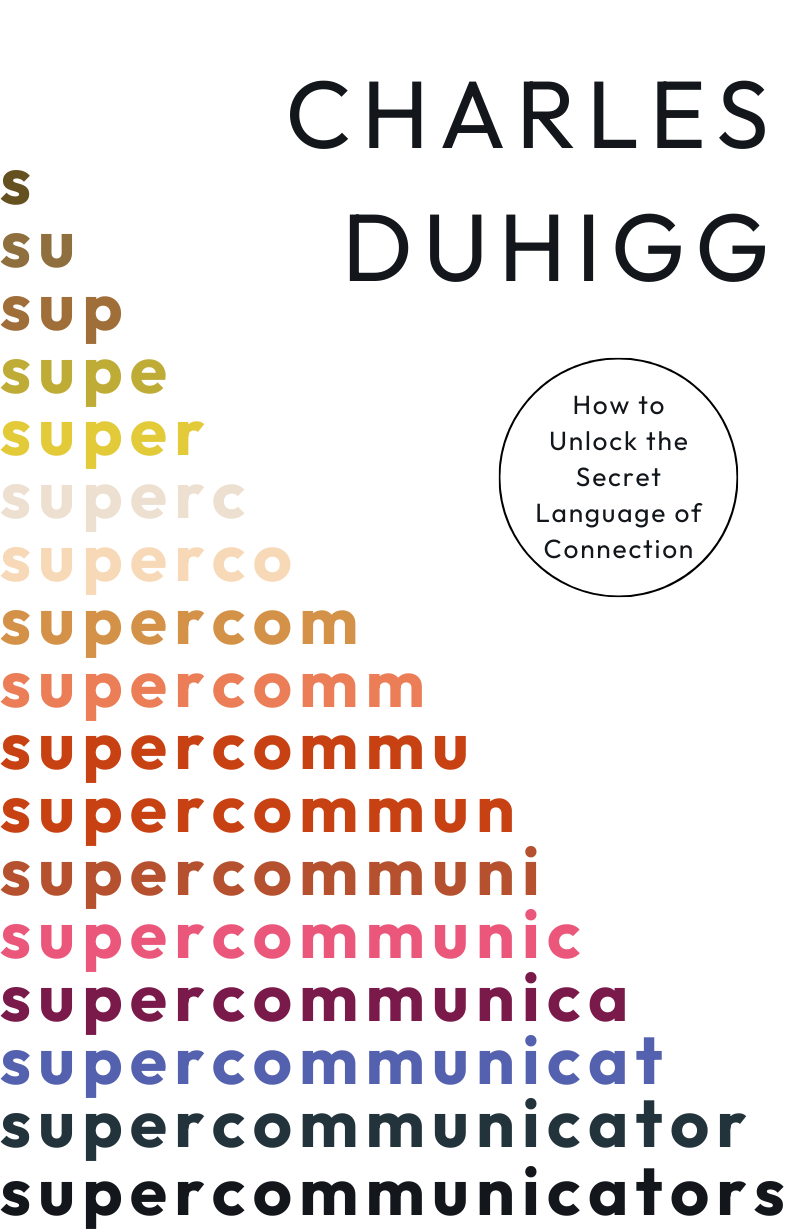 |
How to Unlock the Secret Language of Connectionby Charles Duhigg |
“Simply mirroring someone doesn’t prove that we genuinely want to understand them. What matters isn’t speaking and acting alike, but rather matching one another in ways that convey the desire to align.”CHARLES DUHIGG |
BIG IDEA
Three Kinds of Conversations
FROM THE BOOK“To understand how supercommunicators do what they do, it’s useful to explore what happens inside our brain when we’re in a conversation.
Researchers have studied how our minds function during different sorts of discussions and have found that various neural networks and brain structures become active during different types of dialogue. Simplifying greatly, there are three kinds of conversations that dominate most discussions. These three conversations—which correspond to practical-decision making conversations, emotional conversations, and conversations about identity—are best captured by three questions: What’s This Really About?, How Do We Feel?, and Who Are We? Each of these conversations, as we will see, draws on a different type of mindset and mental processing. When we have a conversation about, say, a choice—a What’s This Really About? conversation—we’re activating different parts of our brains from when we discuss our feelings—the How Do We Feel? discussion—and if our mind doesn’t align with the brains of our conversational partners, we’ll all feel like we didn’t fully understand one another.” |
Brian's Notes
The book has four main sections.
In the first, we identify the three kinds of conversations. Then, in the following three sections, we explore how to best handle each type of conversation.
Here are The Three Conversations:
-
What’s this really about?
-
How do we feel?
-
Who are we?
What we need to know is that each of those types of conversations literally activates a different part of our brains and require a different mindset.
The “What’s this really about?” conversation activates a DECISION-MAKING mindset.
The “How do we feel?” conversation activates an EMOTIONAL mindset.
The “Who are we?” conversation activates a SOCIAL mindset.
Each of those types of conversations/mindsets can be described in another way, which I find to be the most simple and helpful.
Charles tells us: “Some schools have trained teachers to ask students questions designed to elicit their goals, because it helps everyone communicate what they want and need. When a student comes to a teacher upset, for instance, the teacher might ask: ‘Do you want to be helped, hugged, or heard?’ Different needs require different types of communication, and those different kinds of interaction—helping, hugging, hearing—each correspond to a different type of conversation.”
I find THAT distinction REALLY (!) helpful.
When we’re in a conversation, we can literally ask the person with whom we’re connecting: “Do you want to be helped, hugged, or heard?”
If they want to be Helped, that’s a practical What’s This Really About? conversation.
If they want to be Hugged, that’s an emotional How Do We Feel? conversation.
If they want to be Heard, that’s a more social Who Are We? conversation.
That’s a quick look at The Three Conversations. Now let’s take a quick look at how to make our next version of those conversations great!
Big Ideas
01: THE THREE CONVERSATIONS
02: THE FOUR RULES
03: LOOPING TO UNDERSTAND
04: TOUGH CONVERSATIONS
05: THE ULTIMATE RULE
“We all send clues, as we speak and listen, about what kind of conversation we want. Supercommunicators notice these clues, and think a bit harder about where they hope a conversation will go.”CHARLES DUHIGG |
Get all 700+ notes and 101 masterclasses.
Master the Big Ideas from the best books in under 20 minutes a day for one lifetime payment of $99.