Big Idea Daily | My Morning Routine
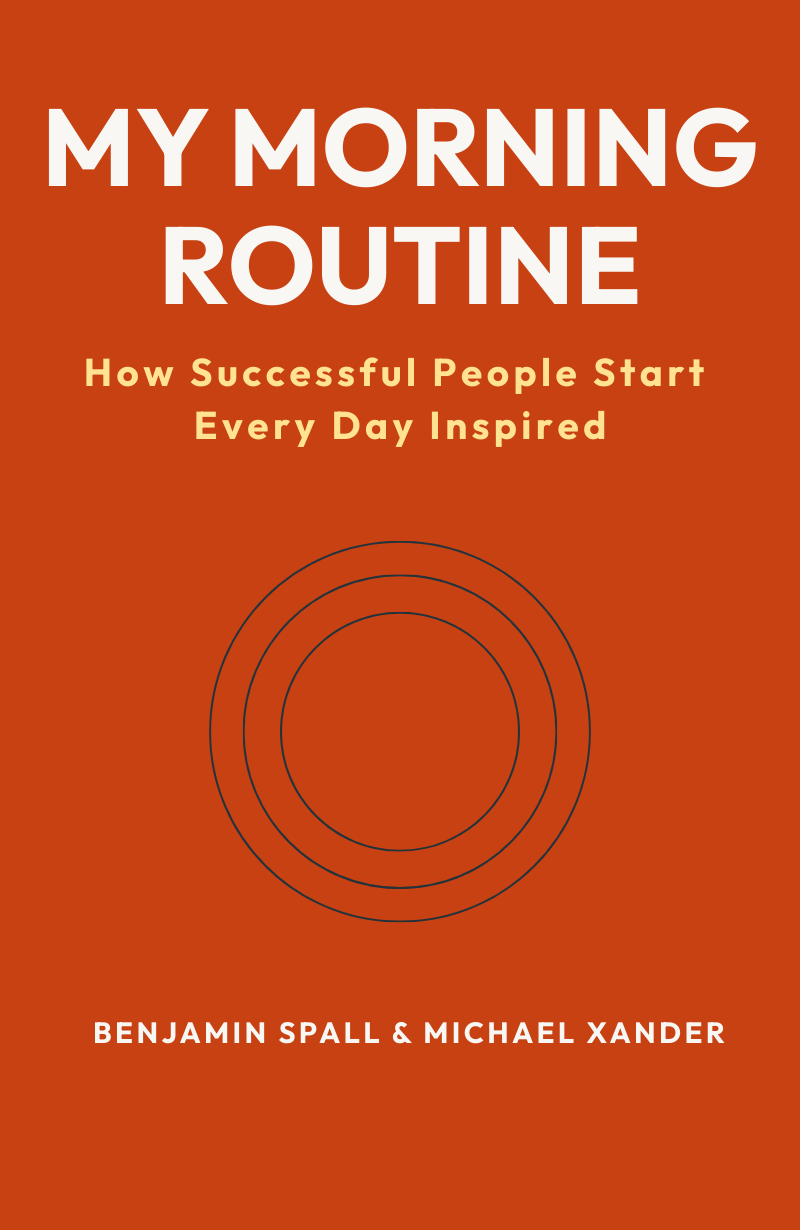 |
How Successful People Start Every Day Inspiredby Benjamin Spall |
“Your morning sets the stage for the rest of your day. That doesn’t mean that you need to get up early: it does mean you should use your morning to do what’s most important to you.”BENJAMIN SPALL AND MICHAEL XANDER |
BIG IDEA
Routines = How to Avoid Decision Fatigue
FROM THE BOOK“Commonly recognized as a reduced ability to make decisions (or rather, to make the decisions you know you should make) due to being inundated with the sheer number of choices we’re faced with on a daily basis, decision fatigue is a harmful psychological state that we all experience from time to time.
Typical methods for reducing decision fatigue in the morning include planning for the next day the night before… and wearing a ‘uniform’ to work every day (a tactic popularized by Steve Jobs, Mark Zuckerberg, and President Barack Obama). Long story short, the less unimportant decisions you have to make in the morning, the more energy you’ll have for all the more important decisions you have to make later in the day.”
|
Brian's Notes
That’s from Chapter 2 on “Focus and Productivity.”
(Spall and Xander look at a range of facets of a great morning routine: from “Getting Up” and “Morning Workouts” to “Morning Meditation” and “Evening Routines.”)
Decision fatigue. It’s real.
Research shows we have a finite capacity to process information and make decisions. Which is why it’s so important to routinize as much of our lives—and especially our mornings!—as possible.
In Your Brain at Work, David Rock echoes this wisdom and tells us how powerful our basal ganglia are at executing patterns. He tells us to: “Use this resource every way you can. Once you repeat a pattern often enough, the basal ganglia can drive the process, freeing up the stage for new functions. Develop routines that can be repeated over and over again.”
He also tells us to: “prioritize prioritizing.”
Specifically, he says: “If Emily knew how energy-hungry her stage was, she would start her Monday morning differently. The big difference is she would prioritize prioritizing. She would prioritize first, before any other attention rich activity such as emailing. That’s because prioritizing is one of the brain’s most energy-hungry processes.
After even just a few mental activities, you may not have the resources left to prioritize. Using your stage for something energy intensive such as prioritizing is like flying one of those toy helicopters you see at parks, the ones that are supposed to be for kids but that dads actually buy for themselves. Once Dad gets the helicopter off the ground a few times, it won’t get off the ground again because the power is too low. It gets close, rising a few inches off, and then collapses back down. And the more you try, the less energy there is. Best to recharge and try again later. In a similar way, doing ten minutes of emailing can use up the power needed for prioritizing. Emily experienced this when she couldn’t ‘see’ how to prioritize her day and ended up dealing with her emails instead.”
In other words, once you blow your brain up with emails and other reactive stuff, it’s REALLY hard to settle it back down to do any meaningful work.
This is why Scott Adams (who’s featured in the book) tells us: “I never waste a brain cell in the morning trying to figure out what to do when. Compare that with some people you know who spend two hours planning and deciding for every task that takes one hour to complete. I’m happier than those people.” (Hah!)
Then there’s the whole discussion around choice in general. See The Paradox of Choice for more on the perils of allowing too much choice into your life.
And, most importantly for our purposes today: Commit to a morning routine. :)
(Spall and Xander look at a range of facets of a great morning routine: from “Getting Up” and “Morning Workouts” to “Morning Meditation” and “Evening Routines.”)
Decision fatigue. It’s real.
Research shows we have a finite capacity to process information and make decisions. Which is why it’s so important to routinize as much of our lives—and especially our mornings!—as possible.
In Your Brain at Work, David Rock echoes this wisdom and tells us how powerful our basal ganglia are at executing patterns. He tells us to: “Use this resource every way you can. Once you repeat a pattern often enough, the basal ganglia can drive the process, freeing up the stage for new functions. Develop routines that can be repeated over and over again.”
He also tells us to: “prioritize prioritizing.”
Specifically, he says: “If Emily knew how energy-hungry her stage was, she would start her Monday morning differently. The big difference is she would prioritize prioritizing. She would prioritize first, before any other attention rich activity such as emailing. That’s because prioritizing is one of the brain’s most energy-hungry processes.
After even just a few mental activities, you may not have the resources left to prioritize. Using your stage for something energy intensive such as prioritizing is like flying one of those toy helicopters you see at parks, the ones that are supposed to be for kids but that dads actually buy for themselves. Once Dad gets the helicopter off the ground a few times, it won’t get off the ground again because the power is too low. It gets close, rising a few inches off, and then collapses back down. And the more you try, the less energy there is. Best to recharge and try again later. In a similar way, doing ten minutes of emailing can use up the power needed for prioritizing. Emily experienced this when she couldn’t ‘see’ how to prioritize her day and ended up dealing with her emails instead.”
In other words, once you blow your brain up with emails and other reactive stuff, it’s REALLY hard to settle it back down to do any meaningful work.
This is why Scott Adams (who’s featured in the book) tells us: “I never waste a brain cell in the morning trying to figure out what to do when. Compare that with some people you know who spend two hours planning and deciding for every task that takes one hour to complete. I’m happier than those people.” (Hah!)
Then there’s the whole discussion around choice in general. See The Paradox of Choice for more on the perils of allowing too much choice into your life.
And, most importantly for our purposes today: Commit to a morning routine. :)
Big Ideas
01: DECISION FATIGUE
02: WHAT NOT TO DO
03: 5 TIPS
04: YOUR LIFE AS AN EXPERIMENT
05: EVENING ROUTINES
“In the morning, alone in my office without interruption, I can write more in the first couple hours of the day than I can throughout the entire next twelve hours.”NICK BOLTON, AUTHOR AND JOURNALIST |
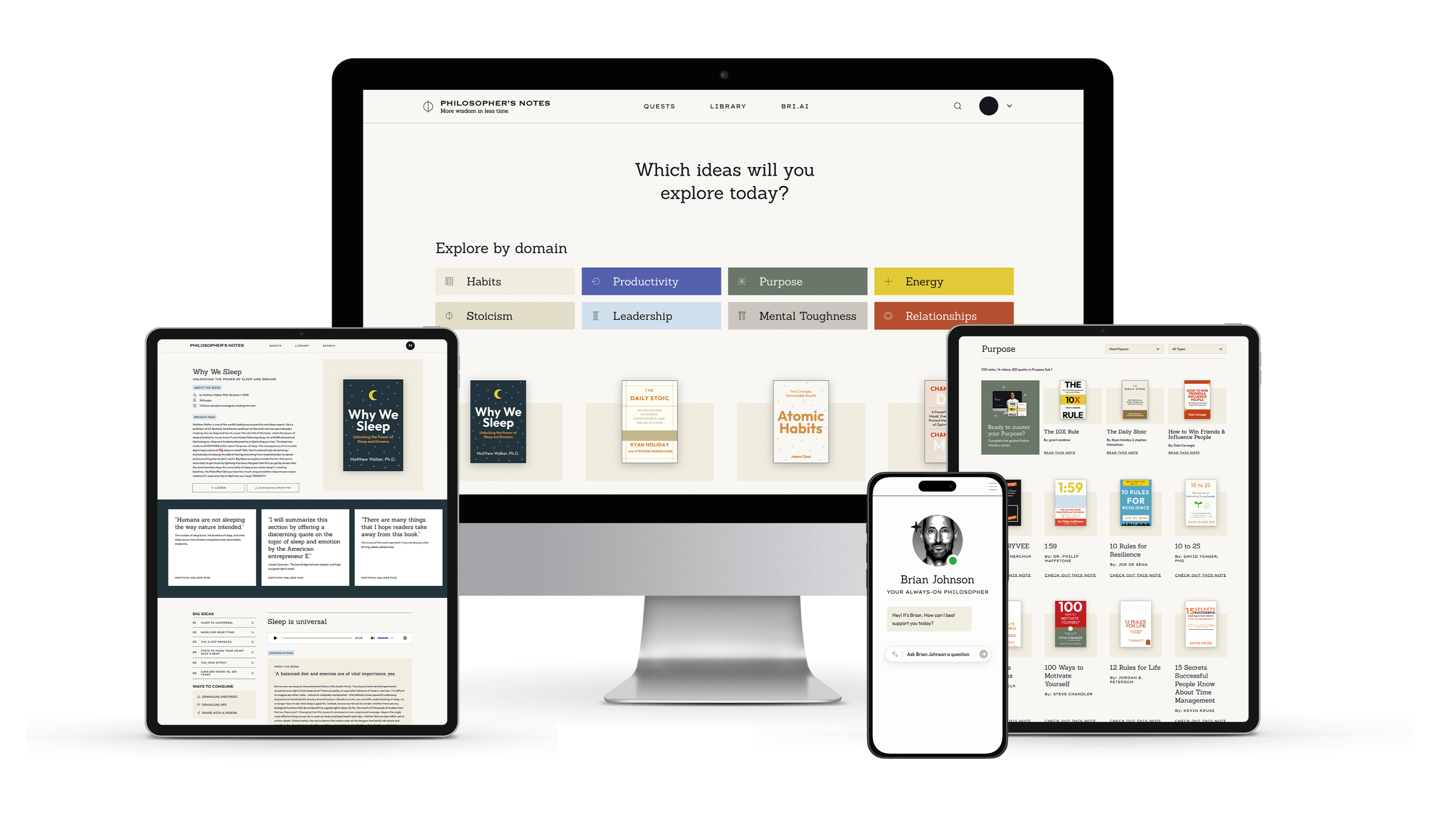
Get all 700+ notes and 101 masterclasses.
Master the Big Ideas from the best books in under 20 minutes a day for one lifetime payment of $99.