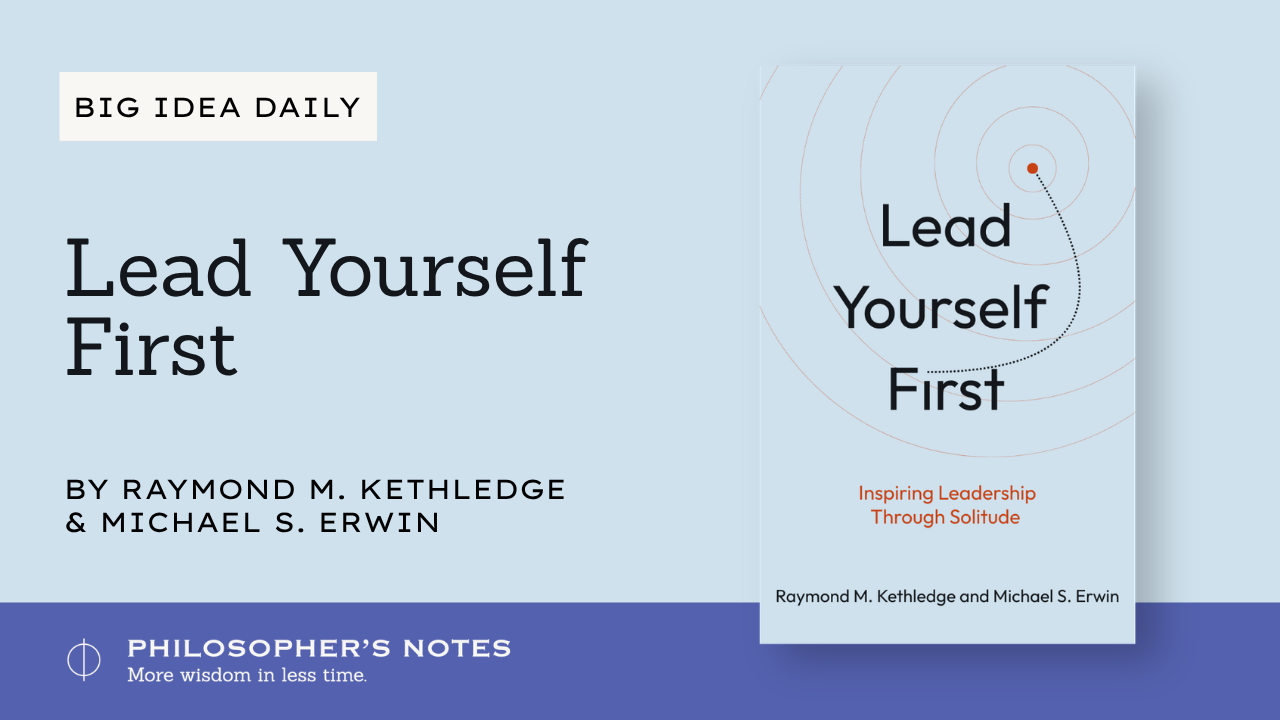
Big Idea Daily | Lead Yourself First
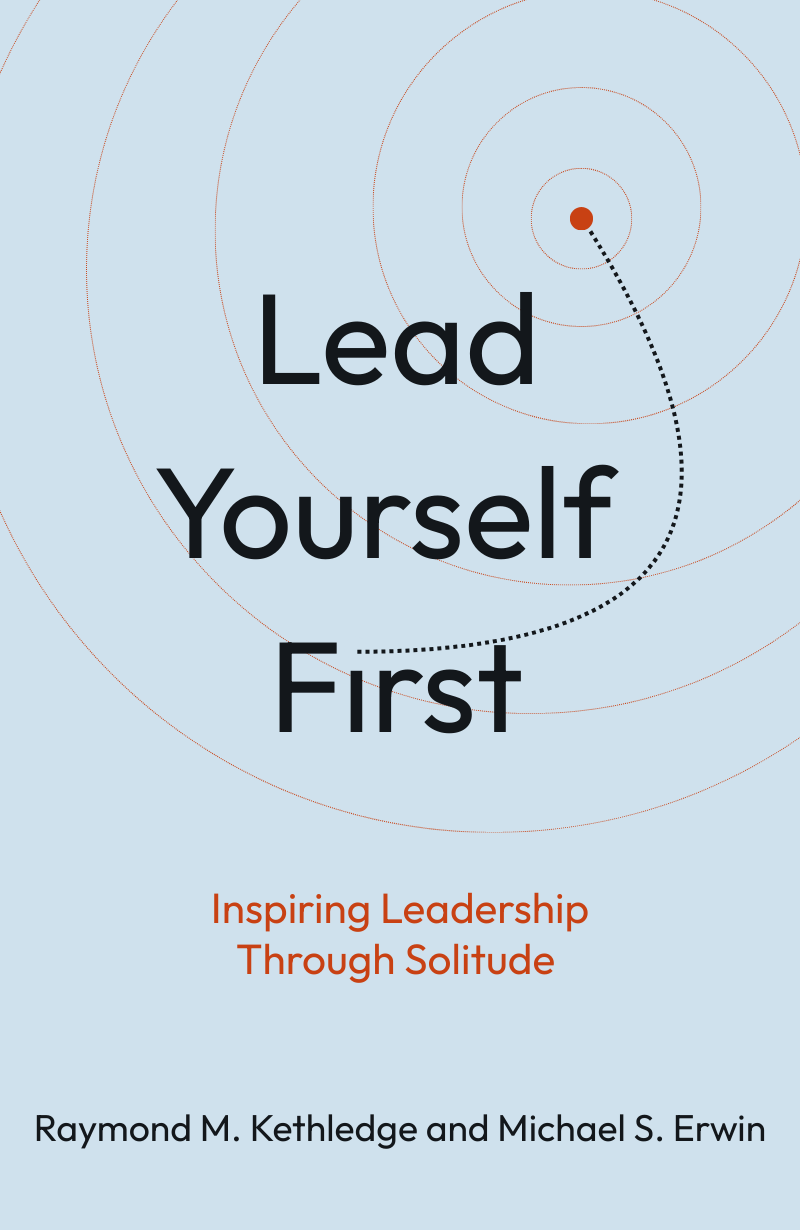 |
Inspiring Leadership Through Solitudeby Raymond M. Kethledge & Michael S. Erwin |
“Solitude is a state of mind, a space where you can focus on your own thoughts without distraction, with a power to bring mind and soul together in clear-eyed conviction. Like a great wave that saturates everything in its path, however, handheld devices and other media now leave us awash with the thoughts of others. We are losing solitude without even realizing it.”RAYMOND M. KETHLEDGE AND MICHAEL S. ERWIN |
BIG IDEA
Solitude in the Input Age
FROM THE BOOK“Solitude has been instrumental to the effectiveness of leaders throughout history, but now they (along with everyone else) are losing it with hardly any awareness of the fact.
Before the Information Age—which one could also call the Input Age—leaders naturally found solitude anytime they were physically alone, or when walking from one place to another, or while standing in line. Like a great wave that saturates everything in its path, however, handheld devices deliver inmeasurable quantities of information and entertainment that now have virtually everyone instead staring down at their phones. Society did not make a considered choice to surrender the bulk of its time for reflection in favor of time spent reading tweets or texts.
Yet, with an awareness of what we have lost, each of us can choose to reclaim it. And leaders in particular—whose actions by definition affect not only themselves—have more than a choice. They have an obligation. A leader has not only permission, but a responsibility, to seek out periods of solitude.”
|
Brian's Notes
Solitude.
It’s been instrumental to the effectiveness of leaders throughout history and now? Poof! It seems to have disappeared—engulfed in the ubiquitous tsunami of information and entertainment.
Step 1. Recognize the fact that a) solitude is a precious resource for leaders (that means: all of us) and b) it’s an endangered species in our modern world.
You know how I like to mention words that are used a lot in books? Well, a word that popped out for me in this book was “inputs.”
Inputs. Inputs. Inputs. Inputs. Inputs. Inputs. Inputs. Inputs. Inputs. Inputs. Inputs. Inputs. Inputs. Inputs. Inputs. Inputs. Inputs. Inputs. Inputs. Inputs. Inputs. Inputs. Inputs. Inputs.
Nonstop inputs via that incessant tsunami of information via emails, texts, news, entertainment, etc. THAT’s what pulls us out of our solitude. We’re constantly reacting to OTHER people’s thoughts—which is why the authors define solitude as “a subjective state of mind, in which the mind, isolated from input from other minds, works through a problem on its own.”
Enter: The “Input Age” (rather than the “Information Age”).
We recently did a Note on a book called Bored and Brilliant. As I was reading this book, I was thinking that a more appropriate title for that book might have been “In Solitude and Brilliant.”
It’s only when we’re in solitude that we tap into our default mode and let it do its thing. And, of course, it’s only in solitude (unplugged from inputs!) that we can go Deep and do our best work.
Even Cal Newport’s Deep Work tip to “Embrace Boredom” can be redefined as “Embrace Solitude.” Embrace those micro-moments of doing nothing. And, as per Thich Nhat Hanh in Silence quit stuffing your brain with all those “nutriment” inputs that your mind will have to digest (kinda like all that edible foodlike substances you might be eating!).
And, let’s recall Herbert Simon’s wisdom that “a wealth of information creates a poverty of attention.” ← We can modify that to “a wealth of INPUTS creates a poverty of SOLITUDE.”
In sum: Solitude = You – Inputs.
Quick check in: What inputs do you KNOW you can eliminate? Today a good day to chip away and carve out a little (/a lot) more space for solitude?
P.S. That passage above was from the very last chapter on “Embracing Solitude” in which we get some great tips on HOW to embrace solitude. Like these: “A leader can designate a certain number of workdays per month as no-meeting days… A leader can mark off sixty or ninety minutes on his calendar each day for time to think. A leader can make it known that he does not text, and checks his e-mail only intermittently or at certain points in the day. (One really has to wonder what leaders who make a point of responding to e-mails within minutes are otherwise doing with their time.) A leader can designate weekends as periods for no work-related emails to be sent at all… Or better yet, a leader can do all these things.”
That little jab at leaders who respond to every email within minutes reminds me of Cal’s definition of Shallow Work and HIS little jab at “human routers”: “In an age of network tools… knowledge workers increasingly replace deep work with the shallow alternative—constantly sending and receiving e-mail messages like human network routers, with frequent breaks for quick hits of distraction.” (Note: Let’s not be human routers. lol.)
The email restrictions idea reminds me of Dan Ariely in Manage Your Day-to-Day where he tells us: “It would probably be best if managers went to the IT department and asked them that e-mail not be distributed between eight and eleven every morning. The idea that the best way to communicate with people is 24/7 is not really an idea about maximizing productivity.”
(I’ve personally decided to get back out of email again. After over a year out I dipped my toe back in and it’s crazy how quickly those inputs can saturate your brain. I’m also no longer using my phone so texts are gone. Of course, as a Professional Optimizer I have fun being extreme. We all need to find the rhythms/constraints that are optimal for us. But I love how this book provided even more clarity on the just how important it is to prioritize our solitude.)
P.P.S. Remember: Solitude = You – Inputs.
(And, with apologies to math geniuses out there: You x Solitude = YOU2)
Big Ideas
01: THE INPUT AGE
02: SOLITUDE’S BIG 4
03: MLK’S MORAL COURAGE
04: FOMO
05: CHANGING THE WORLD
“The first step on the road to experiencing true awareness is the cessation of noise from within.”JANE GOODALL |
Get all 700+ notes and 101 masterclasses.
Master the Big Ideas from the best books in under 20 minutes a day for one lifetime payment of $99.